12 August 2009

Emily Dickinson: Victorian Poetess, Agoraphobe, Fanatic, Social Commentator, and/or Lesbian?

I came across a high school term paper I wrote during the second semester of my junior year in high school (the beginning of 2003). Even then, I was fascinated by the "mystery" surrounding the illusory character that is Emily Dickinson; since writing this paper, I've read multiple biographies and "based on a true story" fictional accounts about her fantastical life. So, allow me to share...

Most every poet, young or old, has probably come across the name of the celebrated Emily Dickinson. The question is: Who is Emily Dickinson and why did she become famous? Miss Dickinson was most likely one of the most enigmatic female poets that has ever lived. From her poems it is simple for one to tell when something in her life directly affected her writing. However, another question a reader must ask is: Did the problems and tragedies in society during her time affect her hidden mysterious lifestyle? By closely analysing her work, it may be possible to determine if she were influenced by the problems of an outside world such as the Civil War, politics, and racial conflicts.

Emily Elizabeth Dickinson was born to Puritan parents on December 10, 1830 in the small town of Amherst, Massachusetts, where she remained for nearly all her life. Her younger sister Lavinia, older brother Austin, and she were forced to comply with the strict Christian beliefs of their tyrannical father. Thus, Emily’s writing often contains religious symbolism and refers to her undying faith. After attending Mount Holyoke Female Seminary for one year, Miss Dickinson returned home out of homesickness. There, she kept herself busy tending her garden, baking up new and delightful recipes, and commencing in writing the first of her poetry.

After some time, Dickinson fell deeply in love for the well-respected and unfortunately married Reverend Charles Wadsworth. When he left for San Francisco in the early 1860’s, Miss Dickinson was compelled to let out her emotions with a stream of disheartening poetry. In the following years, she became increasingly more of a hermit, hardly seeing anyone except her closest family members. Soon she earned the nickname “eclectic recluse,” as she sent sweets and pastries down to children from her bedroom window on the second floor without showing her face. She also refused to meet old friends; instead, she wrote them letters, epigrams, and poetry acknowledging her presence. In 1862, Emily suffered a nervous breakdown, ending the most creatively productive time of her life. Finally at the age of 55, Bright’s disease took her life in 1886 in Amherst (The Academy of American Poets). After discovering 1700+ poems in a desk drawer, Miss Dickinson’s sister published her poetry posthumously. Her fame was spread nation-wide, and now she is considered to be one of the America’s best poets. Emily Dickinson’s lifestyle was definitely an explanation for what inspired her to write poetry, though there are many other reasons. The acme of her life took place during what was deemed to be this nation’s bloodiest war. Through analysing, one can discover how Dickinson dealt with the country’s calamity with words, phrases, and images.

The Civil War took place from 1861-1865 and although it was proclaimed to be “a gentleman’s war” in the beginning, it actually became one of America’s goriest and most horrifying wars. The Civil War itself is linked closely with wounding, connected on various, tangible and intangible, levels. Often the country, the families, the mind, the body, and the spirit were subject to violent ravaging. Any connection from Miss Dickinson to the Civil War is perhaps a bit more difficult to establish; indeed, several scholars have insisted that viewing Dickinson's poetry within the context of the Civil War is nonsense. These analysts prefer to see Emily’s poems as fundamentally isolated successive stanzas. However, in looking at her poetry, it becomes apparent that the work cannot be seen and understood detached from the time in which it was written or the occurring events that mark the period. When Miss Dickinson first viewed Matthew Brady’s photographs of a Civil War battlefield, her reaction was to write poetry. Also, Emily illustrated her deep mourning for soldiers through elegies, defined as “a poem or song composed especially as a lament for a deceased person.” An ode to deceased soldiers such as "It feels a shame to be alive," written the spring of 1863 shows Dickinson’s great concern for the society outside her own prison-like home during the terrible time or war (Susan Belasco).

However, being cooped up in solitude resulted in more than just elegies. Indeed, Emily Dickinson wrote over one thousand poetic masterpieces. Her poems express life, death, hopelessness, and nature, touching the reader with reflections in all aspects of existence.

For example, since most of her poetry was written when she was alone at home in Amherst, her poem about being named ‘Nobody’ was perhaps showing the fact that she was content being by herself and writing in privacy. She was satisfied that she was not a swaggering “frog” that bellowed out accomplishments to deaf or uncaring ears.

“I’m nobody! Who are you?/Are you nobody, too?/ Then there’s a pad of us—don’t tell!/They’d banish us, you know./ How dreary to be somebody!/How public, like a frog/To tell your name the livelong day/To an admiring bog!”


If you look at the poem that begins with "a surgeon must be very careful…," it shows that the worst things can happen from love; however, one must not forget that a surgeon can also perform surgeries to save a person. So in that way, Emily Dickinson could be supporting relationships.

“Surgeons must be very careful/When they take the knife!/Underneath their fine incisions/Stirs the culprit, --Life!”


On the other hand, her poem about having lunch was the opposite. Her words showed that she didn’t have what it took to actually love because she felt “ill and odd.” So instead, she watched others and drew from that.

“I had been hungry all the years;/My noon had come to dine;/I, trembling, drew the table near,/And touched the curious wine./ Twas this on tables I had seen,/When turning, hungry, lone,/I looked in windows, for the wealth/I could not hope to own./ I did not know the ample bread,/’Twas so unlike the crumb/The birds and I had often shared/In Nature’s dining-room./ The plenty hurt me, ‘twas so new,--/Myself felt ill and odd,/As berry of a mountain bush/Transplanted to the road./ Nor was I hungry; so I found/That hunger was a way/Of persons outside windows/The entering takes away.”


Then, in the poem about the angels taking up her tattered heart, she discusses love like it could be something she already rightly experienced and failed in. It also shows her profound love and honour for God, who she deems a person that could save her from misery. That poem easily shows her puritan roots and strict upbringing to believe in God.

“A poor torn heart, a tattered heart,/That sat it down to rest,/Nor noticed that the ebbing day/Flowed silver to the west,/Nor noticed night did soft descend/Nor constellation burn/Intent upon the vision/of latitudes unknown./ The angels, happening that way,/This dusty heart espied;/Tenderly took it up from toil/And carried it to God./There,--sandals for the barefoot;/There,--gathered from the gales,/Do the blue havens by the hand/Lead the wandering sails.”


Also, it seems that Emily Dickinson must have had several opportunities to love, but failed to accept them. This is shown in her poem about the slamming door. It represents how she is too shy to accept an offer to the warmth and comfort of being in love with someone.

“A door just opened on a street—/I, lost, was passing by—/An instant’s width of warmth disclosed, /And wealth, and company./ The door as sudden shut, and I,/ I, lost, was passing by,—/ Lost doubly, but by contrast most,/Enlightening misery.”


Emily Dickinson’s poetry was heavily influenced by the way she lived her life. Even if she lived in seclusion for a good portion of her life, her acquaintances made in her younger years deeply changed her techniques of writing. One of her correspondents, and a close friend/role model in 1862, was the Unitarian clergyman Thomas Wentworth Higginson. After adding a message of advice and support to the young writers of America to the Atlantic Monthly, he received a letter from Miss Dickinson asking to “say if my verse is alive.” It was then that their friendship grew and became to be what is known as the “most provocative correspondence of American literature” (Robert N. Linscott, 3-27).

In her withdrawal from any association with friends or family, it seemed the society only had a minimal effect on Dickinson. Her elegies to honour dead soldiers were the only way she ‘contributed’ to the Civil War effort during the years of 1861-1865.

During her lifetime, Emily was often deemed to be an “eccentric poetess and was given the nickname of the 'Nun of Amherst' upon locking herself away after her father’s death in 1874” (Robert N. Linsworth, 3). Even posthumously she is thought to have been a bizarre and “reckless genius;” her thought process being so entirely different that it is nearly impossible for some to decipher her later work. (Galway Kinnell)

Other critical analysis of Emily Dickinson reveals that her sexual preference could have been for the female sex; consequently, she shut herself away from strangers and only allowed her closest family members to visit her occasionally. For several years, Miss Dickinson and her sister-in-law, Sue Gilbert, ardently wrote letters back and forth. Some historians insist that these letters were merely examples of writing during the Victorian Era. Nevertheless, others like Emily’s biographer Rebecca Patterson, maintained her belief that Emily Dickinson was homosexual. In a work published by Martha Dickinson Bianchi including letters from the correspondence between her aunt and mother, most of the personal conversations between the two were edited. One included this demand made by Emily: “Susie, will you indeed come home next Saturday, and be my own again, and kiss me as you used to?” This statement was edited by Bianchi to simply say: “Susie, will you indeed come home next Saturday?” (Tom and T.J.). As Dickinson lived alone, her intimate life will stay a riddle forever.

Recognized women poets of Emily Dickinson’s time are rare, thus making her one of the most celebrated poets of her gender and era. Her ability to reach the reader with sometimes overly exaggerated messages on life, nature, love, and death is indeed one of the most amazing traits about Miss Dickinson. Her outstanding, though at times quite disturbing, poetry and letters will live on in a daze of baffling reminders of Emily Dickinson’s secluded life.


+Academy of American Poets, The, website accessed 15 March, 2003.
+Belasco, Susan, website accessed 15 March, 2003.
+Linscott, Robert N. Selected Poems and Letters of Emily Dickinson, pages 3-27.
+Kinnell, Galway, website accessed 15 March 2003.
+Tom and T.J., website accessed 15 March, 2003.

Note: Some of these links do not work anymore- it has been more than six years since I accessed these websites.

08 August 2009

Book Review: "Life-Size" by Jenefer Shute.


(Quick note: This book review was written slightly over a month ago, and I'm just getting to posting it here.)

For the first time in years, I finished a book. That book was ~300 pages long, which I devoured (no pun intended!!!) in two days. That book was "Life Size" by Jenefer Shute.

Every quirky thought, mechanical action of the protagonist "Jo" resonated deeply with me. Though deeply disturbing, I found my jaw on the floor- this novel touched on personal thinking processes of someone who had never questioned the eating disorder, and just barely beginning to delve into her past. (However, because it is disturbing and so raw, it could be triggering to some individuals who are actively battling the ED- though honestly, even self-help or "inspirational" stories about EDs could be triggering.)

And what's more: The author never struggled with an eating disorder herself! Don't let that deter you, however. Her novel is not just the typical, stereotyping tale about the upper-class white teenage girl who wants to be pretty and perfect so that Daddy will love her more. She spent a lot of time and effort in researching the mindset of survivors, and it truly shows in her writing.

Honestly, I rarely find anything in books about EDs "novel" or "something that inspires introspection," but while reading "Life-Size," I felt like I was reading my own thoughts, as twisted and inhuman as they are.

06 August 2009

Have a Happy Period.

So, uhm, I don't really have a period- though, granted, I did have one in mid-July, after going 11 months without. (I tell you what: there's nothing like getting your period when you're 8-9 hours away from home with your in-laws on vacation, stranded without supplies because you simply "never bleed anymore," and utterly horrified/shocked that yes, you are indeed still a 23-year-old woman.) It's one of the "joys" of anorexia nervosa, and what doctors call "secondary amenorrhea," explained as losing your period for more than 3 months consecutively (after you've already menstruated before); "primary amenorrhea," however, is when a pre-pubescent/adolescent girl has not had her period after the age of 16, despite all of the other "perks of puberty" having occured. Erm, okay...changing subjects! Well, sort of.

Most commercials bug me. A lot. The sheer number of weight loss and greed-inducing advertisements on the telly these days just infuriate me! Usually, I have quite the opinion on any ad that flashes its piece-of-crap product onto the screen, and more often than not, my opinion is not a very nice one. :D Even commercials for feminine hygiene products (eg, Vagisil, Tampax, etc) can get me riled up. (I think some might call it me being "too sensitive"...or is it "too opinionated"? Haha.)

At any rate, I was surprised when I started getting into the groove and swaying to the beat of a short advertisement's "soundtrack," while I was doing chores around the house one day. It wasn't until I stopped to glance at the television screen, when (imagine my even greater shock!) I realised the music was playing in a commercial for Always Infinity pads! Chuckling, I thought to myself: "Hmmm, is it weird that I really like this otherwise-normal tune?"

I like it so much that I thought I would post the video here, so you could "see the magic show" yourself! Enjoy! :D

03 August 2009

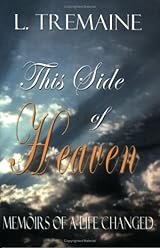
Book Review: "This Side of Heaven" by Lorna Tremaine.

I met Lorna by chance, while attending Cornerstone Church one Sunday back in March of 2008. I needed a place to sit, but all the chairs and tables inside were taken- all but a lone chair next to her.

Me: Mind if I sit there? Is that seat taken?
Her: No, not at all... go ahead!

And that began our conversation. I explained to her that I was temporarily living in Chandler, AZ, but my home is in CA. What I did not tell her was that I was living in AZ because I had just spent 60 days at Remuda Ranch, an inpatient facility for eating disorders, and then transferred to Remuda Life, a residential/step-down facility (for EDs).

She smiled, and said she was from CA, too. We talked about how awesome Cornerstone Church is/was, chatted about the little things. When it was time for me to go with the other girls and staff inside the church, she told me how nice it was to talk to me, as she had attended church alone that day. She handed me a business card and a bookmark that had her name, phone number, email address, and website on them. She hugged me, and shocked at the kindness of a stranger, I said goodbye.

This chance encounter is what truly changed my views on people, especially folks who attend church. I was a staunch atheist, with great fear when it came to hypocrisy within the church, for 21 years. Lorna changed my perspective a great deal...

A couple months later, when I had gone back home to CA, I was leafing through my Bible that I had received there at Cornerstone Church (nope, I didn't have one before that). Her bookmark fluttered to the ground. I picked it up, and, my curiosity piqued, I visited her website called Living Life with Victory.

Her words and insight were so inspiring! I decided to send her an email, expecting her to have forgotten all about me. Nope, she remembered just who I was, and excitedly asked if she could send me a copy of her relatively new book "This Side of Heaven." Of course, I said "yes!"

A couple weeks later, the package showed up, and from page one, I was hooked. Her autobiography details just how she gained a personal relationship with God, despite all the of the difficulties and obstacles to overcome in her life. The fact that she WASN'T "perfect" and acknowledged that even Christians can come from broken pasts showed me that I didn't need to "keep up appearances" if I accepted Christ as my Saviour. Her book/memoirs showed me how she was able to grow after being victimised and used by others, in order to gain a life of freedom to do what she was created to do. And what's more is that, even though I had not even whispered that I struggle with an eating disorder, her book talks about how she got into recovery from anorexia nervosa!

Not only is Lorna Tremaine an amazing and victorious woman of God, she is a fantastic writer, with passion for and understanding about life.

28 July 2009

Sick of the LIES (and the Media's False Promises).

So...this new show "Drop Dead Diva" is supposed to be all about "fat tolerance," right? Well, friends, in reality, it is: 1) just dreadful and offensive, 2) completely ridiculous if it's trying to represent "real life"/make some kind of point about "fat discrimination" (the whole flipping show is discriminatory itself!), and 3) a total disappointment when it comes to Margaret Cho (I expected better from her!!!)... The whole show just comes off as cliche after cliche, stereotype after stereotype. BLAH, changing the channel, moving on.

I can't wait to see that new show "More to Love" by the producers of The Bachelor. (Actually, I can't wait to rip it to shreds- I'm already irritated about it.) Can you believe they ACTUALLY had the gall on the preview advertisements to say that the curvy women on "More to Love" are "real women," implying that, if you're a size 2 or 4 (or whatever), you aren't a "real woman"?! Ugh, I'm just so tired of a society that is so body-focussed. WHO CARES? Why not just enjoy people for their conversation and the fun you have with them?

It's just all such a bore; I used to be into shows like that (eg, "The Biggest Loser"), but now, I'm at the point where I ask: "Oh my gosh, MOREEEE of this?" And of course, the latter example just irks the he__ outta me, because I've read first-hand accounts that contestants have written, detailing how they descended into EXTREMELY disordered behaviours (restricting, over-exercising, purposely dehydrating themselves, etc), just to "make weight" and win all that cash. It's like, what started as a want to become healthier turns quickly into a competition just to see who can kill themselves faster. It disgusts me that the rest of the world sees this, and then, feeling ashamed and guilty, a watcher (or 2, or 3, or million!) thinks they have to lose the weight just like the contestants on the show. What they don't see is all of those terrifying, life-threatening measures the competitors take just to drop the weight, week after week. Nor does the audience remember that these people are away from home (hence, the "average stressors" of a job, school, kids, spouse, friends, family, etc), have dietitians/chefs giving them "healthy" portions, and personal trainers to push them to keep going. (I compare this sort of environment to what we go through while in treatment- we're in a "bubble," so to speak, so even if we are doing everything right while there, things could easily change when we get back home...and "REAL LIFE.") So, of course, someone who watches "The Biggest Loser" will be disappointed and frustrated that they aren't losing weight (or losing quickly enough, losing enough weight period, lack of dedication, etc) to the show's specifications.

And that's just a tiny piece of the puzzle- I cannot STAND the way the trainers treat their clients! Screaming at them, yelling curses and insults, re-enforcing weight loss (not effort) with compliments, and not promoting healthy body image/beliefs. It's all just a game, media exposure, a job, and lots of money for those trainers (Jillian Michaels, Inc., ESPECIALLY!). Whew, that was a lot to get off my non-existent chest.

16 July 2009

Whistles and Cat Calls.

First of all, let me premise this by saying that I am in no way saying that all men are like this, nor am I blaming the entire male gender. I know that the specimens below are just extraordinarily rude and disrespectful examples, who just so happen to be part of the "rugged sex." Also, please excuse my rant, and if you can offer any advice, wise words, or even a passionate retort...please please please- feel free to send an e-mail (no matter what your gender is)!

Where I live, I do a lot of road running. I try to stick to running away from the busy roads, but sometimes, it's unavoidable. Also, it gets hot here- REALLY HOT. Today, we'll hit 105 degrees by noon. So, I typically stick to a modest sports bra (good coverage, minimal bouncing, etc) and tight Lycra shorts (don't like the flappy, wind-up-your-shorts bottoms). This leaves my stomach, legs, and arms exposed. When I run (or walk, of late, as I've been having arch/knee problems), I enjoy putting my headphones on and jamming to some good beats. I always take care to carefully observe my surroundings, however, and keep the music at a volume where I can still hear what's going on around me.

Alright, now that I've explained all that: WHY is it that I should have to put up with getting: honked at, yelled at from idiots hanging out their windows, whistled at, and even cat-called? I mean, one time, I was even startled by some hooligans pumping their hydrolics in their stupid modified/lowered truck! (Later that day, I went for a slow jog in my neighbourhood, and some dorkus drove by slowly, his window rolled down, and when he saw me, he gave me this really patronising face and flashed two thumbs up at me, while exaggeratedly mouthing "GOOD JOB." /eyebrow raise)

My husband argues that it's to be expected in society and he understands why guys do it, because it's "an uncivilised man's way of pursuing a woman" (I think that's pretty much what he said, in fewer words). At first, I was really ticked off that he'd basically condone it (and, as I perceived, was saying that it'd be okay if he did it himself). He clarified and said that he didn't think it was right, but understood it.

This was my thought of the issue: Why should I just have to put up with the taunting and jeers? Why should I have to just say: "Oh well, boys will be boys!"? Not only that, but if a "man" were truly using cat-calling as a "way of pursuing a woman"... how does that even work? Obviously, it has nothing to do with trying to impress me or get to know me, because they speed away after startling the living he__ outta me! I just can't accept or justify my husband's logic.

Come on! My heart rate is already pumping when I'm running, so I certainly do NOT need it to be sped up even more by being startled or scared silly by some immature jerks! (One time, some idiots randomly honked at me, causing me to jump, then stumble, and almost fall face-down in the dirt! The nerve!) Not to mention, I've now had to start wearing more clothing, despite sweat pouring into cracks and crevices it should never go, because I don't want to attract any more attention than I already do by just running/walking. Lately, I've even started to feel nervous or paranoid to go running by myself (the only way I can run, since I don't have any friends that will go with me, and my hubby hates any other sport besides wakeboarding). I don't want to be worried or scared about leaving my house to walk in my own neighbourhood!

So, in closing, my question is this: Why are these actions considered appropriate or "okay"? And what more can I do to help prevent this (or do I just have to somehow "deal with it")?!

16 June 2009

The F-Word.

Gordon Ramsay.
What don't I love about Gordon Ramsay?


I love Kitchen Nightmares, both UK and USA programmes, but man, do I love The F-Word. The music is brilliant, Ramsay is smokin', and what else? The programme is completely and utterly "ADHD" like me. Typically, I can't sit and watch television for very long, because my brain wanders, I get antsy, and need to get up and "take a break." Same goes for films- it's been AGES since I've been to a proper show.

But The F-Word flits back and forth between different topics, heavily seasoned (excuse the pun!) with humour and interesting topics. And yes, Gordon Ramsay is one of my "favourite celebrities"- he's just so sexy!

Anyone else with me on this?
Bookmark and Share